Dual-class Shares Are Coming Under Fireã¢â‚¬â€again
Feb. xv, 2018
Cheers so much, Steven (Davidoff Solomon), for that kind introduction. I'k delighted to be back on the Berkeley campus. It was just a yr agone that you lot graciously hosted me hither as a visiting professor at Berkeley Police force. So I am not simply excited to be here today—I'thou as well honored to offer my first public remarks as an SEC Commissioner among and so many friends and colleagues.
Earlier I get started, allow me just note that the views I express here are my ain and do not reverberate the views of the Committee. (Although, I'll confess, I hope someday that they do.)[1]
My first few weeks at the SEC have been a whirlwind—and just to be clear, I am not talking about the markets. In a few short weeks, I have gotten a crash grade on SEC policymaking—and enough reading to empathize with my one-time law students, who used to tell me, to my puzzlement, that my Corporate Police syllabus was non exactly beach material.
Simply in between the policy memos that come across my desk-bound, I've too had the pleasure of working with my new colleagues on the SEC's Staff. They've taught me a lot in a brusk time, and I'g grateful for their insights and assistance. The hard work and dedication of these folks gives me confidence that we are upwardly to the challenge of making sure our financial markets are the safest, strongest, and most efficient in the world.
And so the first few months of 2018 take been quite a mistiness. Fortunately, they accept not been as stressful for me equally the last few months of 2017.
You run across, last autumn, I took office in two of the most nervus-wracking Q&A sessions of my life. In tardily Oct, I had the ultimate job interview: a ii-hour, televised confirmation hearing in front of the Senate Banking Committee.[2] And so, ii months later, I found myself the one posing the life-changing questions. I asked my girlfriend Bryana to marry me.
I'yard happy to report that, to my surprise, both Bryana and the Senate offered a resounding yep—literally inside 24 hours of each other. Simply, permit me just say, I now have newfound respect for the staff and Senators on the Commission. I only had to ask one question, and it nearly gave me a heart assail.
At present, as a newly engaged guy, I fully embrace the notion that a potent marriage must be built on a foundation of eternal trust. But today, I would like to enquire whether information technology is wise to use that standard to corporate governance. Should our public investors have to place eternal trust in corporate insiders? That is, should and then-called perpetual dual-class stock ownership structures, which grant corporate executives control of our public companies literally forever, be adequate?
The Law and Legacy of Dual-Class Stock
As you know, "dual form" voting typically involves capitalization structures that contain two or more classes of shares—one of which has significantly more voting power than the other. That'south distinct from the more common single-class structure, which gives shareholders equal disinterestedness and voting power. In a dual-class construction, public shareholders receive shares with one vote per share, while insiders receive shares that empower them with multiple votes. And some firms have recently issued shares that requite ordinary public investors no vote at all.[3]
For most of the modern history of American equity markets, the New York Stock Exchange did not list companies with dual-form voting. That's because the Exchange's commitment to corporate democracy and accountability dates back to before the Swell Depression.[4] But in the midst of the takeover battles of the 1980s, corporate insiders "who saw their firms as being vulnerable to takeovers began lobbying [the exchanges] to liberalize their rules on shareholder voting rights."[5] Facing pressure from corporate management and beau exchanges, the NYSE reversed grade, and today permits firms to go public with structures that were once prohibited.[half-dozen]
Equally you all know well, more and more companies choose today to go public with dual-form. Public companies using dual-class are today worth more than $5 trillion, and more than 14% of the 133 companies that listed on U.South. exchanges in 2015 accept dual-class voting.[7] That compares with 12% of firms that listed on U.S. exchanges in 2014, and just i% in 2005. [8]
There'southward a long-running debate on dual-class. On one hand, you have visionary founders who want to retain control while gaining access to our public markets. On the other, you accept a structure that undermines accountability: management can outvote ordinary investors on virtually anything.
In that location is reason to think that, at least for a defined period of fourth dimension early in a company's life, dual-grade can be benign. The structure can allow entrepreneurs to build for the long term—and fifty-fifty transform entire industries—without being subject area to short-term pressure.[9] When many managers are at the mercy of daily stock-market force per unit area, dual-course can assist America's well-nigh innovative companies create the sustainable long-term value nosotros need to grow our economy.[ten]
Many have argued forcefully, withal, that one-share, one-vote should be the dominion for all public corporations.[11] Whatever the benefits may be of permitting dual-class in a few well-known cases, these advocates argue, the costs for investors—who are left with no way to agree management'south feet to the fire while dual-class is in identify—outweigh those benefits.
But the question I want to ask today is not whether dual-grade ownership is always skilful or bad. Information technology's whether dual-class structures, once adopted, should last forever. Do Principal Street investors in our public markets benefit when corporate insiders maintain outsized command in perpetuity?
This is not an academic exercise. Y'all see, virtually one-half of the companies who went public with dual-class over the final 15 years gave corporate insiders outsized voting rights in perpetuity. Those companies are request shareholders to trust management's business judgment—not just for five years, or ten years, or even 50 years. Forever.
Corporate Royalty and Our Values
So perpetual dual-class ownership—forever shares—don't simply ask investors to trust a visionary founder. It asks them to trust that founder'southward kids. And their kids' kids. And their grandkid'southward kids. (Some of whom may, or may not, be visionaries.) It raises the prospect that command over our public companies, and ultimately of Main Street'due south retirement savings, volition be forever held past a modest, elite group of corporate insiders—who will laissez passer that power downwards to their heirs.
I cannot come across how to foursquare that with our nation's foundational ideas.[12] In America, we don't inherit power, and we don't hold power forever. We fought a state of war against that system, and the good guys won. That's why, post-obit Thomas Jefferson's lead in Virginia, after Independence, state governments "laid axe to the root of pseudo-aristocracy," equally Jefferson put information technology, by abolishing the laws of entail and primogeniture.[13] It's why our Constitution gives our legislature the broad authority to promote the general welfare, but advisedly enumerated what Congress cannot exercise: grant titles of nobility.[14] It's why our founders rejected a permanent dual-class legislature: a House of Lords for the royalty and a House of Commons for Primary Street.[fifteen]
Now, our public markets aren't our government, but our country's spirit of democratic accountability has long blithe how nosotros remember about economics. That's why Adam Smith worried in his early writings about how economical models could account for the possibility that power could be wielded by royalty from beyond the grave.[16] And that's why today we crave companies to give investors regular updates on their performance. If yous run a public company in America, yous're supposed to be held answerable for your work—possibly not today, peradventure non tomorrow, just someday.[17]
So i problem with perpetual dual-class is it removes entrenched managers—and their kids, and their kids' kids—from the discipline of the market forever. Simply put: asking investors to put eternal trust in corporate royalty is antithetical to our values as Americans.[eighteen]
Perpetual Dual-Class Stock and Corporate Performance
It's not just that perpetual dual-class stock ownership is disconcerting in principle. The data suggest that it is troubling in practise. And I know this because my staff and I ran the numbers. More on that in a moment.
Just permit's beginning with what existing research in this surface area tin already tell us. 1 recent study shows that the costs and benefits of dual-form structures evolve over a company'southward lifetime.[nineteen] Shortly after the IPO, dual-grade firms trade at a premium—merely, as the company matures, this premium eventually disappears. Early in a company'due south life, then, giving control to the business firm's visionary founders makes sense—just at some point that structure is no longer beneficial.
For that reason, some contend that dual-class firms should include some limit on the amount of time earlier ordinary shareholders tin can weigh in on whether dual-form yet makes sense for the visitor.[twenty] Whether a fixed term of years or upon a founder'due south passing, at that point, sometimes called a "dusk," shareholders become to have their say.
To explore these questions, my staff and I took a shut expect at 157 dual-form IPOs that have occurred over the past xv years. We immediately noticed some pretty meaning differences betwixt the 71 dual-class companies with dusk provisions and the 86 who gave insiders control forever. Our regression models predicted relatively similar valuations at their IPO dates, a tendency that continued for two years after the IPO. But over time, their predicted valuations diverged:
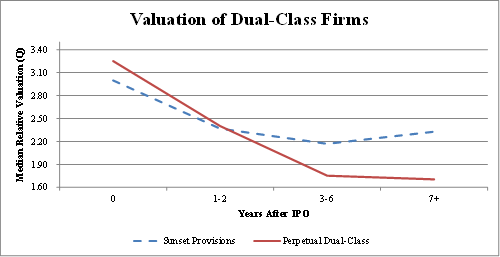
Seven or more years out from their IPOs, firms with perpetual dual-class stock merchandise at a significant disbelieve[21] to those with sunset provisions.[22] We also found that, amid the small-scale subset of firms that decided to drop their dual-class structures afterward in their life cycles, those decisions were associated with a significant increase in valuations.[23] To be sure, our analysis is preliminary, and this is a subject that deserves much further study. In the spirit of a robust debate, I am making public the results of our assay every bit well as our underlying data and assumptions.[24]
The Path Alee
I'm not the only one concerned about dual-grade stock and its furnishings on our markets. Investors take loudly and conspicuously registered their objections to this structure, both through the SEC's Investor Informational Committee and the Council of Institutional Investors.[25]
As a result of that appointment, iii major providers have moved to exclude dual-class companies from significant stock indexes. FTSE Russell will exclude all companies whose free float constitutes less than five% of total voting ability;[26] Due south&P Dow Jones will, going forward, exclude all dual-class firms;[27] and MSCI volition reduce the weight that dual-class firms occupy in its indexes.[28]
Investors, facing a moving ridge of companies using dual-class to insulate their managers from accountability, have every right to bring those complaints to index providers. And at that place's no doubt about it: the indices' decisions sent a loud message to the markets.[29] But excluding all dual-class firms from our major marketplace indices is a edgeless tool. And it's i I'yard deeply worried virtually.
Let me explain why. Nosotros face a growing gap in this country between our markets and Master Street investors. The eye course watches our markets rise and increasingly—and correctly—senses that they are left out, that the benefits of that growth are accruing to someone else. And middle class investors frequently own stock in American public companies through an index. Though their holdings may be pocket-sized, those holdings reverberate their participation in our economic future.[xxx]
If we ban all dual-class companies from our major indices, Chief Street investors may lose out on the gamble to be a part of the growth of our most innovative companies. The next Google or the next Facebook will deliver spectacular returns, but boilerplate Americans will, quite literally, not be invested in their growth. No one hither in Silicon Valley should want to go out average Americans out of their growth story. And investors should non be forced to choose existence long American innovation and signing up for corporate royalty.
That'due south why I hope that our national securities exchanges volition shortly consider proposed listing standards addressing the employ of perpetual dual-class stock. Such standards would allow Main Street investors to share in our economic system's growth—but avoid asking them to trust corporate management forever. Companies would still exist able to IPO with dual-class voting arrangements—but only if management is willing to someday give shareholders their say.[31] And while cynics may say that companies will flee abroad to list, I think it's pretty unlikely that we'll see a mass exodus of listings away from the deepest, most liquid capital markets in the globe just and so founders' children tin inherit and run America's public companies.
* * * * *
While information technology is fair to ask people to place their eternal trust in their partner, our country's founding principles and our corporate law counsel against the creation of corporate royalty. The solution to that problem is non to leave ordinary Americans out of the growth that all of yous here in Silicon Valley are creating. The solution is to render to the tradition of accountability that has served our nation and our markets then well.
Equally a Commissioner, my job is to pursue a iii-function mission at the SEC: protect investors, maintain fair and efficient markets, and facilitate uppercase formation. All 3 would be advanced if the exchanges promptly pursue this issue. By giving investors more say in the governance of their companies, nosotros can assistance protect them from managers who would misuse dual-course to excerpt value rather than build it. By providing articulate rules of the game for both shareholders and management, nosotros help them understand and price the risks they're taking. And by giving visionary founders the infinite to control their companies presently afterwards their IPO, we encourage them to use our public markets—and share their growth with Master Street investors.
The exact form that exchange standards might accept—and the best way to "sunset," or limit, dual-class structures—is beyond the scope of my talk today. And too, I have no doubt that the folks in this room can come up with innovative ways to solve that trouble.[32] I know that all of yous share my goal of finding a way to allow today's visionaries to access our public markets in a way consistent with our values. And I urge yous all to become to piece of work, alongside our exchanges, to brand certain that Primary Street investors share in the future you're shaping here every mean solar day.
[i] I am deeply grateful to my colleagues Matthew Cain, Caroline Crenshaw, Marc Francis, Satyam Khanna, and Prashant Yerramalli, whose invaluable insights have deepened my thinking on these matters a keen deal. Responsibility for any errors or omissions is mine lonely.
[ii] To be fair, I'chiliad using the phrase "televised" a little loosely here. Because my Mom and Dad were present at my confirmation hearing, I'yard pretty sure viewership was close to zero.
[three] Snap Inc., Form S-1 (February ii, 2017) ("Holders of our Class A mutual stock—the only form being sold in this offering—are entitled to no vote on matters submitted to our stockholders.").
[4] In 1926, the NYSE's famous determination to list nonvoting shares in Dodge Motor Company resulted in a public outcry. In response, the Exchange announced that information technology would consider voting control when making listing decisions, and in 1940 the NYSE announced a flat policy confronting nonvoting common stock. Prior to these events, restrictions on shareholder voting rights were more common. See Stephen Bainbridge, ProfessorBainbridge.com, Agreement Dual Class Stock Role I: An Historical Perspective (September nine, 2017). And then again, prior to these events, the Securities and Commutation Commission did not be.
[5] Stephen M. Bainbridge, Comments to the Securities and Exchange Commission on No. 4-537: The Telescopic of the SEC'south Potency Over Shareholder Voting Rights (May 7, 2007).
[six] The SEC, led at the fourth dimension past Chairman Arthur Levitt, attempted to intervene—but was thwarted by a controversial ruling of the D.C. Circuit. Business Roundtable v. SEC, 905 F.2nd 406 (D.C. Cir. 1990).
[7] Wall Street Journal Business Web log: The Large Number, Wall. St. J. (Aug. 17, 2015).
[eight] These trends are consistent with those noted by an insightful preliminary written report past the Investor equally Possessor Subcommittee of the SEC'southward Investor Advisory Committee. Run into SEC, Investor Informational Committee, Word Typhoon: Dual Course and Other Entrenching Governance Structures in Public Companies (December 17, 2017).
[9] See, e.thou., Alphabet Investor Relations, 2011 Founders' Letter ("In our feel, success is more likely if you lot concentrate on the long term. . . . For case, it took over three years just to ship our kickoff Android handset, and and then another three years on top of that before the operating system truly reached disquisitional mass.").
[10] See, e.m., Sens. Elizabeth Warren & Joe Donnelly, Trump'southward SEC Chairman Must Look Out for American Families, Not Large Corporations, Wash. Post. (March 22, 2017) ("[S]hortsighted corporations [are] chasing quick profits at the expense of their workers and the long-term health of their companies."
[xi] See, east.g., Quango of Institutional Investors: Dual-Course Stock (Jan. 2018), at http://www.cii.org /dualclass_stock ("CII continues to view one-share equal voting rights upon IPO as the optimal approach.").
[12] Many prominent dual-class companies and their managers seem to understand this problem and have addressed the business concern. Run into, e.chiliad., Sujeet Indap, Dual-Course Shares Should Build in Expiration Programme, Fin. Times (October 26, 2017).
[13] The Elusive Thomas Jefferson: The Human being Behind the Myths 38 (M. Andrew Holowchak & Brian W. Dotts eds., 2012) (quoting an early alphabetic character from Jefferson to John Adams).
[14] U.S. Const. fine art. I § 9, cl. 8 ("No Title of Dignity shall be granted by the The states: And no Person holding any Office or Profit of Public Trust under them, shall, without the Consent of the Congress, accept whatever present, Emolument, Role, or Title, of whatsoever kind whatever, from any King, Prince, or foreign Land.").
[15] Publius, The Federalist No. 63 (B. Wright ed., 1961) (arguing, by dint of comparing betwixt the proposed Senate and the British House of Lords, that the one-time was non, and was unlikely to become, "[]confined to particular families and fortunes[ or] an hereditary assembly of opulent nobles.").
[sixteen] Samuel Fleischacker, On Adam Smith's "Wealth of Nations": A Philosophical Companion (2014) (quoting Smith'due south lectures on jurisprudence).
[17] Casablanca, Dir. Michael Curtiz (Warner Bros. 1942).
[eighteen] The thought that full-bodied corporate power is held in just a few individuals' hands and will be passed down to their heirs is made all the more troubling by the fact that then few corporations today wield and so much influence over and so many American lives. I wonder how many of the problems plaguing our securities markets today tin and should exist treated by that sometime, familiar, and uniquely American medicine: competition.
[19] Martijn Cremers, Beni Lauterbach, and Anete Pajuste, The Life-Cycle of Dual-Grade Firms (Jan. 1, 2018), at https://papers.ssrn.com/sol3/papers.cfm?abstract_id=3062895.
[20] Lucian Bebchuk & Kobi Kastiel, The Untenable Case for Dual-Class Stock, 103 Va. L. Rev. 585 (2017).
[21] For our principal assay nosotros appraise value with a much-maligned mensurate of corporate performance: Tobin's Q. Important recent work, however, has shown the danger in relying exclusively on Tobin's Q for purposes like these. Run into Robert P. Bartlett & Frank Partnoy, The Misuse of Tobin'due south Q (Feb four, 2018); see besides Emiliano Catan & Michael Klausner, Board Declassifications and House Value: Accept Shareholders Really Destroyed Billions in Value? (October 10, 2017). Then nosotros re-ran our analysis using monthly equal-weighted portfolio returns for the perpetual sample versus the sunset sample. Nosotros did this in both calendar fourth dimension and so, separately, in event time, with each house'southward life bike starting at zero and proceeding for 48 months. Nosotros then constructed a long-curt cumulative return for the difference betwixt the two portfolios, and the results are very consistent with those described in a higher place.
[22] One might inquire why we compare firms with perpetual dual-course to those with dual-class sunset provisions rather than firms with a single class of stock. We practise this because we, like scholars in the expanse, worry that any effort to match perpetual dual-course firms with single-course firms will omit important differences that cannot exist adequately controlled for. Run into Cremers, Lauterbach, and Pajuste, supra. Since our sample includes only dual-class firms, we avoid the possibility that underlying differences between unmarried-course and dual-course firms drive our results.
[23] This evidence does not, of course, establish that perpetual dual-grade structures cause firms to suffer lower valuations. It may exist, for example, that the causal arrow runs the other way: that firms anticipating that they volition be worth less later in their life bicycle select perpetual dual grade structures. Either mode, the evidence suggests that this governance structure is associated with lower firm value. These data brand it unsurprising that investors have expressed such pregnant concern about the use of dual form.
[24] I could diameter y'all with the details of our regressions, fixed effects, and amassed standard errors, only I know that's not what you came to hear about. Instead, I'll point the interested listener to the information appendix to this speech, where you tin can learn more than about our methodology and analysis. I hope that this start step volition help bring increased academic interest to dual-class stock—and the ongoing argue almost its costs and benefits for investors.
[25] See Investor Advisory Committee, supra; Council of Institutional Investors, supra.
[26] FTSE Russell, FTSE Russell Voting Rights Consultation: Next Steps (July 2017), available at http://world wide web.ftse.com/products/downloads/FTSE_Russell_Voting_Rights_Consultation_Next_Steps.pdf.
[27] S&P Dow Jones Indices, Conclusion on Multi-Class Shares and Voting Rights (July 2017), available at https://www.spice-indices.com/idpfiles/spice-assets/resource/public/documents/561162_spdjimulti-classshares andvotingrulesannouncement7.31.17.pdf?force_download=truthful.
[28] MSCI, Consultation on the Treatment of Unequal Voting Structures in the MSCI Equity Indexes (January 2018), at https://www.msci.com/documents/1296102/8328554/Consultation_ Voting+Rights.pdf.
[29] Encounter, eastward.g., Matt Levine, List Standards and Dividend Shares, Bloomberg View: Money Stuff (Apr 13, 2017) (arguing that excluding firms on the ground of governance characteristics is a "weird role" for stock indices, and pointing to the "long tradition of corporate governance standards beingness imposed past stock exchanges as 'listing standards,' a sort of seal of approval . . .").
[30] Edward N. Wolff, Household Wealth Trends in the United States, 1962 to 2016: Has Middle Class Wealth Recovered? (November 2017, NBER Working Paper No. 24085).
[31] Some may argue that, since investors can price the effects of perpetual dual-course at the IPO phase, in that location is no need for such standards. I am unconvinced that the IPO markets we have today reverberate the kind of efficiency that argument demands. In whatever result, exchange standards need not require dual-class to cease—just that shareholders get to vote on the structure. If managers can convince the markets of their merits, they'll be free to retain dual-form.
[32] For innovative proposals in this respect, run into Bebchuk & Kastiel, supra, at 619-628.
Source: https://www.sec.gov/news/speech/perpetual-dual-class-stock-case-against-corporate-royalty
0 Response to "Dual-class Shares Are Coming Under Fireã¢â‚¬â€again"
Post a Comment