Bravely Default Job Costumes Art of Bravely Default Agnes
| Bravely Default | |
|---|---|
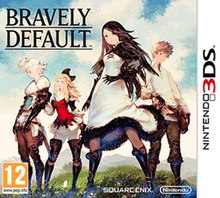 European box fine art | |
| Developer(s) | Silicon Studio |
| Publisher(s) | Nintendo
|
| Managing director(s) | Kensuke Nakahara |
| Producer(south) | Tomoya Asano |
| Designer(s) | Kensuke Nakahara |
| Artist(south) | Akihiko Yoshida |
| Writer(s) | Naotaka Hayashi Keiichi Ajiro |
| Composer(s) | Revo |
| Platform(s) | Nintendo 3DS |
| Release | October 11, 2012
|
| Genre(southward) | Role-playing |
| Mode(s) | Unmarried-player |
Bravely Default , known in Japan as Bravely Default: Flight Fairy ,[a] is a role-playing video game adult by Silicon Studio for the Nintendo 3DS handheld console. Bravely Default was originally released in 2012, while an expanded edition subtitled For the Sequel was released in 2013 in Japan, Europe and Australia, and in 2014 in North America. This expanded edition used the subtitle Where The Fairy Flies in territories exterior of Nippon. Square Enix published the game in Nippon, while Nintendo handled publishing duties overseas. The gameplay uses a turn-based boxing organisation and chore system, in addition to incorporating options to combine job abilities and suit battle speed and random encounter rates.
Bravely Default is set in the world of Luxendarc, which is kept in residual past four elemental crystals protected by the Crystal Orthodoxy, a religious group with influence beyond the world. The story follows the adventures of iv protagonists: Agnès Oblige, vestal of the Air current Crystal, who was forced out of her duties after the crystals were consumed past darkness; Tiz Arrior, the sole survivor from a destroyed village acquired by the crystals' blight; Ringabel, an amnesiac philanderer trying to uncover a mysterious periodical in his possession; and Edea Lee, a defector of a large regular army aptitude on capturing Agnès. Together, the party aims to reclaim the iv crystals from the darkness and face a greater evil along the way.
Starting development every bit an action role-playing sequel to Final Fantasy: The 4 Heroes of Lite, it retained elements from the Final Fantasy series while having its own story and gameplay elements. The producer of The 4 Heroes of Light, Tomoya Asano, returned to produce Bravely Default. The story's writer was Naotaka Hayashi, who was brought in from 5pb. due to his work on Steins;Gate. The characters designs were handled by multiple artists, including art director Akihiko Yoshida and mangaka Atsushi Ōkubo. The game was influenced past western video games and television serial, and individual elements were inspired by aspects of the Dragon Quest serial and Higurashi When They Cry. The music, composed past Revo of Sound Horizon, was intended to evoke the feelings of classic series such as Dragon Quest and SaGa.
Bravely Default was first announced in September 2011 as office of Nintendo'southward 2012 lineup for the platform. In the run-up to release, multiple demos were adult, and the team adjusted the game using feedback from players. For the Sequel was the ground for the overseas release, being localized without any subtitle. In both Japan and overseas, Bravely Default met with strong sales and critical acclaim. Common praise went to the gameplay's mixture of traditional mechanics and new elements, forth with its storyline, graphics and music. Main points of criticism were its repetitive belatedly-game stages and elements of its social gameplay. Bravely Default spawned multiple media tie-ins and spin-off games. A direct sequel, Bravely Second: Terminate Layer, was released in 2015 in Nippon and 2016 overseas for the Nintendo 3DS, while another sequel set in a new world, Bravely Default II, was released worldwide in 2021 on the Nintendo Switch. The Bravely series has shipped over 3 meg copies by November 2021.[1]
Gameplay [edit]
Bravely Default is a role-playing game (RPG) which features a political party of four characters navigating the fantasy world of Luxendarc. Navigation in towns, dungeons, and the earth map environments are presented in an angled, third-person overhead view: the graphic symbol remains even so, the camera zooms out to a distant view. These environments are displayed on the top screen of the Nintendo 3DS system, while the bottom screen displays maps of environments, party stats and other information such as item menus. On the world map, a day-dark cycle alters the types of enemies nowadays, and after a certain point in the story an balloon can be used to speed up travel and access previously inaccessible areas. In towns, players tin can collaborate with non-playable characters (NPCs), purchase items or magic at specialized shops, buy or sell weapons and equipment at an armory, or rest at an inn to restore health points (HP) and magic points (MP). In all environments, the party can notice chests containing items, weapons or equipment. During certain points, a Political party Chat choice appears, giving players the option of initiating conversations between the party members.[2] During exploration, standard enemies appear through random encounters: outside battle, the meet rate can be adapted from loftier to cipher. The game features multiple difficulty levels, which tin be adapted freely outside boxing.[2] [iii]
Outside the main campaign, the game uses networking features powered by the 3DS's StreetPass functionality. A central chemical element is the entrada to reconstruct the hamlet of Norende, destroyed at the get-go of the game. The village is constructed on new ground subsequently obstacles are removed and an expanse is prepared. The reconstruction incorporates social game elements: friends encountered by the actor through StreetPass and online invites become the hamlet's residents, and their efforts are used to create various buildings including houses and shops. The amount of time a project takes to complete depends on the number of friends assigned to it, taking anywhere from days to weeks. Increasing the number of people speeds up the towns' reconstruction. As the reconstruction progresses, the player is awarded with new items and equipment. Individual buildings will gain experience points, granting admission to higher-tier rewards, and players take the option of adjusting the types of items rewarded. Special randomly generated optional bosses, known as Nemeses, will appear in the region. Defeating them yields special rewards.[ii] [4]
Battle system [edit]
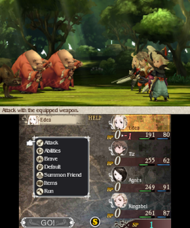
Screenshot of a boxing in Bravely Default, showing the party fighting an enemy group. The battle is shown on the upper screen, while the party's command menu is shown beneath.
Battles come up in 2 types: random encounters with standard enemies, and staged boss battles. The battle system revolves around turn-based combat: each side is allowed to perform an action or multiple actions, with each grapheme having contained movements and commands: these deportment include attacking with the equipped weapon, using magic, or using an detail. The party also has the choice to escape from almost battles. Ii new options to the boxing system are the Brave and Default options. Brave Points (BP) dictate the number of actions a graphic symbol or enemy can take within a turn, along with being needed for the execution of certain abilities. Party members can utilize BP downward into negative figures, enabling up to four actions within a single plough. When the BP guess is into negative figures, they must wait for the BP counter to reach cypher before they can act again. BP are naturally recovered once per plough. Alternately, any party fellow member can Default, which reduces the damage taken by enemy strikes and accumulates BP.[two] [3] [5] An additional power is "Bravely 2nd", an ability which freezes fourth dimension for the enemy, allowing a party member to movement 4 times in a single plow with no cost. Bravely 2nd requires Sleep Points, or SP, a currency which is either replenished while the Nintendo 3DS is in sleep manner or through buying regenerative SP Drinks through microtransactions. Battle speed during gainsay can be sped upwards or returned to normal at the player's discretion.[two] [v]
Tied into the boxing system is a Job organization: start with the Freelancer, the party can gain boosted Jobs past obtaining gems chosen "asterisks" from defeated man bosses. Xx-4 Jobs can exist found in the game, ranging from the agile Valkyrie to White and Black Mages that respectively specialize in healing and fighting magic. Each Chore has different strengths and weaknesses in battle. Outside battle, characters tin exist assigned whatsoever available Chore. In addition to the skills of the equipped Job, the skills of a second Job tin can be learned, allowing for complimentary customization of parties and the mixing of Job abilities in battle.[ii] [3] [5] Afterwards obtaining the Summoner Job, characters tin can use summoned monsters to launch attacks that deal loftier harm on all enemies. Friend characters tin can likewise exist summoned from other players' games: the more a friend summon is used, the more effective their deportment get.[2] [6] Descriptions of defeated enemies, along with story recaps and descriptions of locations, weapons, and Jobs are included in an item called D's Journal.[2]
Inside sure weather condition, characters tin can perform Special Moves, customizable powerful moves tied to Jobs: later on a Special Move is performed, the entire party is granted buffs for a express period. This flow is represented with a specific tune that plays over normal battle music. Various elements can be added to Special Moves, such as granting elemental properties, launching status ailments at enemies, recovering HP and MP, and temporary status ailment amnesty to the party. The customization of Special Moves is directly tied to the creation of specialist shops during the reconstruction of Norende.[two] [4] Experience points acquired at the end of a battle enable characters and their assigned Jobs to level up, unlocking new abilities and boosting character stats such as bachelor HP and MP. Bonuses are gained if the party fulfilled certain conditions. Job abilities and levels tin as well be borrowed from online friends, in a feature called Abilink. Any Task can exist borrowed from available players regardless of their current level.[2]
Synopsis [edit]
Bravely Default is set in the world of Luxendarc, which is kept in balance past 4 elemental crystals which are protected and venerated by the global religion known equally the Crystal Orthodoxy. 1 day, the crystals are consumed past darkness and the world is thrown into chaos with numerous calamities. Agnès Oblige, vestal of the Wind Crystal, escapes while the rest of the temple'due south worshipers perish to protect her. At the same time, a great chasm opens up below the hamlet of Norende, killing all of its inhabitants except a young shepherd named Tiz Arrior. When he returns to the chasm hoping to detect other survivors, he meets Agnès and her fairy companion Airy. The three are then attacked by forces from the hostile Duchy of Eternia, who seek to preclude Agnès from awakening the crystals. After defeating the soldiers, Tiz decides to travel with Agnès as her protector. They return to Caldisla, where they are also joined by Ringabel, an amnesiac vagabond who holds a volume predicting hereafter events, and Edea Lee, an Eternian soldier who becomes disillusioned and defects after her commanding officer commits war crimes. The political party travels to the Temple of the Current of air Crystal showtime where Blusterous instructs Agnès on how to awaken the crystals through prayer. The party visits three of the four temples and awaken each of the crystals from darkness, beingness confronted past the forces of Eternia as they proceed. During their journeying, the group is aided past the ancient Sage Yulyana and observed by the immortal Lord DeRosso. The political party eventually reaches Eternia, the domicile of the Earth Crystal, and are forced to defeat the Duchy'southward leader, Edea's male parent Braev Lee in battle. A column of light then appears in the ocean in the South East near the desert country of Ancheim once the Globe Crystal is awakened. Airy instructs the others to have her to the Holy Pillar of Light. Afterwards the group fend off Edea'south close friend Dark Knight Alternis Dim, whose face is identical to Ringabel's, Airy's ritual is completed and the party is blinded by the vivid light surrounding them and blacks out.
The group awakens and they find themselves back in the Kingdom of Caldisla where the game started. They quickly learn that Blusterous'southward ritual had instead sent them into a parallel world, with Blusterous unsure of how whatever of it actually happened. They also first to detect a change in the blueprint on Airy's wings which originally resembled the number 5 and at present resembles the number 4. They resolve to reawaken the crystals as they accept been corrupted over again, not knowing what else to do, and the process is repeated multiple times; in each of the v worlds the grouping travel through. They notice and awaken the corrupted crystals, Airy performs her ritual in the Holy Colonnade of light, they are thrown into a new parallel world, and the blueprint on Airy's wings continues to count down towards 0 with each new world. In each world, they discover variations on the situations they encountered in their own earth, and gradually learn several truths virtually themselves and their adversaries. About all of the Eternian elite they face were taken in by Braev out of pity as they were rejected by the Orthodoxy, and Yulyana and DeRosso are revealed to be Braev's allies and key figures in cleansing the Orthodoxy of its abuse. During the group's travels, both Yulyana and DeRosso give subtle warnings to Tiz and Agnès most Airy's truthful intentions with Yulyana adding that they should "Have the backbone to think and act on their own. And accept the courage to disobey." Ringabel, revealed to be a version of Alternis Dim who got dragged into the original group'due south Luxendarc, slowly regains his memories of pursuing the party of his earth before witnessing them being killed by Airy subsequently she turned into a monster. By this indicate, even the game hints at Airy's true intentions on the title screen afterward selecting your save file every bit most of the letters in the game's sub-championship ("Where the Fairy Flies") vanishes from the screen eerily leaving backside the message "Airy Lies." In truth, Airy has been manipulating the party and Agnès to not just awaken the crystals, just to transport their ability out of control in lodge to link the all of the parallel worlds to enable her master, the demon Ouroboros, to achieve and conquer the Angelic Realm.
Depending on the role player'southward actions, ii dissimilar routes could play out. In the normal road, triggered if Agnès chooses to destroy i of the crystals in their awakening later on figuring out Airy's scheme ("Accept the courage to think and act on your own, and have the courage to disobey."), Airy attacks them in a fit of rage. The grouping then pursues her to the Dark Aurora, a realm of darkness near the chasm, and defeat her; her final words claim Ouroboros is yet a threat to the earth. In the canonical true road, should the role player awaken the crystals across four dissimilar worlds, Airy reveals herself and is defeated by the party. She so retreats to the Great Chasm which now has been shrouded in an eerie fog. The grouping goes to Yulyana and DeRosso, who reveal a message left by an "angel", a version of Agnès from some other world who was betrayed by Airy; the two have been planning for Ouroboros' arrival, and the grouping resolves to end the demon. They travel to the Dark Aurora over the Great Chasm and catch upwardly with Airy, who is granted her ultimate form by her master. Despite this, the party defeats Airy, who is then devoured by Ouroboros. After revealing that Tiz is being kept alive by a being from the Celestial Realm, Ouroboros attacks, and DeRosso sacrifices himself to restrain the demon's regeneration. The party are temporarily stopped when Ouroboros begins consuming worlds to regain forcefulness, but alternate versions of them interruption the links formed by Ouroboros, giving the political party a adventure to destroy him. Once defeated, the links to the other worlds through the Great Chasm begins to close. Before the path between worlds closes, they return to their ain world.
In the epilogue, Agnès and Edea return to their corresponding groups to better relations between the reformed Orthodoxy and the Duchy; Ringabel returns to his own world and reclaims his identity as Alternis Dim; Tiz is rendered comatose later on going to Caldisla's graveyard and releasing the Celestial Being within him. In a special video teasing the second game, Tiz wakes in a life back up tank in Eternia before existence rescued from captivity by the mysterious Magnolia Arch.
Development [edit]
According to producer Tomoya Asano, Bravely Default began evolution as a sequel to Final Fantasy: The 4 Heroes of Light (2009), and would have been part of the Final Fantasy franchise.[7] After completing The 4 Heroes of Light, Asano considered what he wanted to do side by side. Despite having the option to developing something within Foursquare Enix's core franchises, he wanted to practise something new, establishing a new make.[eight] During this initial phase, the original development squad reached out to Silicon Studio, whose previous work was mostly related to development middleware. Silicon Studio developed a well-received demo for the project and were assigned to develop the game. Despite moving away from the Last Fantasy series, it retained a boxing system and world setting in common with many Final Fantasy games. Co-ordinate to Asano, this was both a leftover of the project'south original form and a conscious choice to give players from the Final Fantasy series a sense of comfortable familiarity.[7] [ix] In later responses to fan questions, Asano confirmed that he designed the Final Fantasy-style story so players would have little trouble inbound the earth. The story-telling and gameplay was heavily influenced past western video games and television set series. Asano described the result as a "Japanese RPG with American content thrown in".[10] The main claiming for the team was making Bravely Default a traditional RPG without overloading it with nostalgic elements. Despite this, every bit the team were fans of both Terminal Fantasy and Dragon Quest, nostalgic features were added for genre veterans and exist appreciated by newcomers.[11] Asano wanted to bring together what he considered the three cadre elements of RPGs (battles, growth, and connectedness) in Bravely Default. An important element was creating a casual feel that anyone could relish, even if they had never played an RPG.[eight]
During development, the squad decided to cater for the core Japanese RPG fanbase, equally they did not believe the game feasible for Western release at the time.[12] At the early stages of development, Bravely Default was going to be an action role-playing game, a genre Silicon Studio had previously worked on with 3D Dot Game Heroes. After developing a prototype build and putting it before Asano, it was decided to make the battle system a traditional plow-based model.[9] The interdependent "Dauntless" and "Default" mechanics underwent changes during the development procedure. Initially, Asano envisioned a system akin to the Tension stat used in the Dragon Quest series, but designer Kensuke Nakahara wanted something more than exciting for players. He was also annoyed that the majority of bosses in both Dragon Quest and Final Fantasy got two or more actions per turn while player characters only got one each.[11] [thirteen] Afterward some consideration, Nakahara decided on a organization where characters could bank points by not taking deportment during a plough for later use, or create loan points to human action multiple times in a current turn.[xiii] The concept of "D's Periodical", which would offering players deeper insights into the earth and characters of Bravely Default, was inspired past a similar organisation from Higurashi When They Cry.[xiii] During the late stages of the game's development, the team had to make several last-infinitesimal tweaks and changes to ensure the game delivered the all-time possible performance.[14] Due to the game's called mechanics, balancing the game became a major part of afterwards evolution.[eight]
The core concept of Bravely Default was divers by Asano as "everyone can play", equally he wanted to bring positive elements from the growing social game market into Bravely Default.[8] The social gameplay was made upwards of three unlike elements: the ability to utilize StreetPass friends to assistance reconstruct Norende, the power to summon friends' characters into battle as a summon, and the "Abilink" option which allowed players to infringe each other's task levels.[15] The initial versions of these functions were non as elaborate as they would become in the terminal product. Norende Hamlet was initially displayed on a single screen, but at a proffer from Asano it was enlarged so players needed to slide the display around. The summoning choice was initially going to exist a simple brandish of the summoned character, but it was decided to make the summoning sequence more elaborate. The summoning text initially shared fonts with other elements, but as Asano wanted it to take more impact, a more florid font was used. This styling was influenced by a sequence featuring Japanese idol group AKB48 in an unspecified tv drama.[fourteen] The usage of StreetPass was incorporated to differentiate Bravely Default from other RPGs of the time, forming part of Asano'due south wish to create something new.[8] A notable feature included in the game were augmented reality (AR) movies. The AR movies were adult using a software evolution kit provided by Nintendo and implemented into the game past Silicon Studio.[nine] A unique gimmick included in the game was using the platform's photographic camera to project the actor's image into an expanse of the arena during the final boss battle.[16]
The game'south music was composed by Revo, the leader of Japanese musical grouping Sound Horizon. Asano contacted Revo concerning a collaboration as he had listened to his 2004 anthology Chronicle second. During his work, Revo was able to see the game's ROM, and then discuss the game'southward vision and development goals with Asano. While the initially-agreed runway number was between 20 and 30, the number of tracks almost doubled during production equally Revo saw situations that needed their ain music. Revo aimed for a nostalgic musical style, referencing the music and atmosphere of Final Fantasy, Dragon Quest, and the SaGa serial.[17] During recording, tracks were given descriptive working titles, such every bit "Scene of Normal Boxing" or "Song of Asterisk Holder Warfare". Multiple battle songs were created for the game, each having a faster tempo depending on the escalating battle situation.[14] Revo's recording sessions were closely linked with the creation of the game's sound source, and so the music would fit onto the 3DS' limited storage infinite without losing too much of its quality. One time the music was recorded, a sound environment was created and so that it could be heard clearly through the 3DS system's speakers. While at that place were concerns nigh the 3DS cartridge'southward storage space limitations, these ultimately proved to exist minimal.[13]
Scenario and graphic symbol design [edit]
The game'due south title represented the game's main theme of self-reliance: not blindly following the will of others, and following your own will. "Bravely" symbolized backbone, while "Default" symbolized denial.[16] [xviii] The subtitle was ane of many proposed by the team, and was chosen by Asano after it helped give an official name to the character Blusterous: prior to this point, she had gone unnamed and was generally referred to as a "Navi grapheme".[16] The subtitle was also a coded reference to Airy'southward truthful agenda and the game's deliberate removal from the Final Fantasy series.[19] The primal words created for the initial draft scenario were "large hole", referring to the Bang-up Chasm beneath Norende, and "parallel earth", which referred to the many versions of Luxendarc encountered by players during their journeying.[14] The greater majority of the master scenario and side quest storylines were fully voiced, with the master cast having a huge corporeality of dialogue compared to other characters.[20] The summons were themed after classical elements, modernistic mechanism and multiple globe mythologies.[6]
The game'southward script was written by Naotaka Hayashi, a staff writer at 5pb. whose most notable work at the fourth dimension was visual novel Steins;Gate. Later playing through Steins;Gate on the recommendation of some other staff member, Asano decided that Hayashi would be able to create the highly-seasoned characters and surprising scenario needed for the story, and asked 5pb. if Hayashi could work on Bravely Default.[18] Another reason Asano wanted Hayashi was due to the plot's heavy employ of parallel worlds.[14] Hayashi's work on the game involved creating the plot and grapheme settings. While he wrote the bulk of the game's dialogue, more detailed piece of work was given to writers at Square Enix and Silicon Studio.[eighteen] One of the supplementary writers was Silicon Studio's Keiichi Ajiro, who wrote the contents of D'south Journal. Ajiro also created the initial story outline with Asano. The initial story concept was kept deliberately elementary, but its complexity increased during the writing process.[16] During his work, Hayashi was given guidelines past Square Enix almost the characters and story: for case, Asano wanted the heroes and villains to be equally compelling, along with raising the game's targeted age grouping.[18] Something that Hayashi needed to think during the writing procedure was the demand to limit the length of dialogue segments. While visual novels had a high elbowroom for dialogue quantity, Asano would make requests such as a judgement being within a 22-character limit, and to not overrun into multiple dialogue boxes.[fifteen]
The chief character designer and art managing director was Akihiko Yoshida, whose previous notable works include Final Fantasy Tactics and Tactics Ogre: Permit Us Cling Together. In contrast to much of his previous artwork, Yoshida created the game'southward artwork using a stronger blueprint and coloring style. His artwork for Agnès was designed to stand for her solitude and noesis of her fate while also displaying cuteness and motherliness. Tiz's design was designed not to convey a strong personality, as he in part represented the player. For the game'due south environmental artwork, Yoshida drew on European children'due south literature. The in-game environments such as towns and the overworld were created using specially drawn art mapped to a pseudo-3D layout. This style was meant to emulate archetype picture show books. Finalization of the art style took a long period, going through extensive trial and mistake.[21] Designs for many of the secondary characters were handled by other artists: Atsushi Ōkubo, who had most notably worked on the Soul Eater manga series, designed Einheria and the Valkyrie chore outfits. Erutus Profiteur and the Merchant job designed past Hideki Ishikawa, whose work included character designs for Lord of Vermilion arcade game series. Kamiizumi and the Swordmaster task were designed by Dorin Makoto, who had well-nigh notably worked on the Sengoku Basara serial. Blood-red Mage Flore DeRossa and the Ruddy Mage chore was designed by Take, who worked on the Katanagatari lite novel series. Qada and the Salve Maker job were designed by Midori Foo, an artist who had worked on multiple light novels and online games.[22]
Release [edit]
Bravely Default was first announced in September 2011 nether its original Japanese championship as role of Nintendo'due south 2012 lineup for the 3DS, alongside titles such as Monster Hunter 4 and Fire Emblem Awakening.[23] Between February and September 2012, v different demos were released through Nintendo eShop. The first demo featured Agnès and demonstrated graphic symbol control.[24] The second, released in March, featured the graphic symbol Tiz and town exploration.[25] [26] The third demo, released in June, showcased the battle organisation and introduced Edea.[27] The 4th demo, released in August, featured the grapheme Ringabel and demonstrated the job and character customization systems.[28] The 5th and final demo, released in September, included features from all the previous demos and included elements such every bit Friend Summons, and the Abilink and Norende reconstruction social elements. With the release of the 5th demo, the sale of the other demos was discontinued.[29] The demos were developed alongside the main game as stand-lonely experiences taken from several points inside the game. They as well ended upwards providing the squad with feedback for gameplay adjustments.[13] Each demo included an AR movie featuring one of the main cast.[9]
Bravely Default released on October 11, 2012. Information technology was published by Square Enix. Along with the standard edition, Square Enix created a collector's edition for exclusive sale through their online store. The collector's edition featured an AR poster, a first print re-create of the game'southward soundtrack, an artbook, and a themed 3DS protective example.[30] Downloadable content in the form of additional grapheme costumes were made bachelor both through promotional codes and post-release content.[31] An updated edition of the game, titled Bravely Default: For the Sequel,[b] was announced in August 2013 in Weekly Shōnen Jump for a release on December v that year.[32] For the Sequel was stated to accept over a hundred different improvements and adjustments: these included additional salvage slots, additional difficulty levels, car saving options, the addition of new subevent scenes, new gameplay elements such as the "Bravely Second" ability, and subtitles in multiple languages. Many of these alterations were based on questionnaires sent out by the company after the original version's release. According to staff, For the Sequel was intended every bit a "trial version" for its sequel, already in evolution after the success of Bravely Default.[33]
Localization [edit]
Prior to any official announcement of its Western release, Bravely Default was cited by multiple journalists as a game that should be localized for Western markets.[34] [35] [36] In Oct 2012, Asano stated that there were no plans to localize the game, but that fans should continue inquiring then that their wishes were made clear.[viii] A localization was officially appear in April 2013. Nintendo took charge of publishing duties overseas.[37] The Western version was based on the For the Sequel expanded version.[38] Information technology released in Europe on December half dozen, 2013.[39] An earlier false report in Nintendo'southward financial report indicated that its European release would exist in 2014, but this was later corrected by Nintendo of Europe.[40] In Australia, information technology released on Dec seven.[41] In Northward America, it released on Feb seven, 2014.[42] Both in North America and the UK, a collector's edition was created including the soundtrack, an artbook, and over xxx AR cards.[42] [43] The Uk edition also included a figurine of Agnès.[43] It was also released in Southward Korea on April 16, although it was not localized into Korean, placing it in contrast with other Nintendo releases such as Shin Megami Tensei 4.[44]
The localization itself was handled by Beak Blackness and his company Binari Sonori, whose previous work included Demons' Score for Square Enix and World of Warcraft: The Burning Crusade for Blizzard Entertainment.[45] Another fundamental staff member was Timothy Police, a localization editor from Square Enix who supervised the translation and vocalisation recording for the title. An element of the localization that provided a claiming was creating a sense of wordplay equivalent with that used in the original Japanese. An instance of this was the Performer job and its owner, the latter of which needed to have her commencement name adjusted while taking into consideration European gender perceptions. Another instance from the dialogue was the need to create jokes that would not work in Japanese, such as Agnès commenting on finding a "lucky charm". The subtitle "Flying Fairy" was removed for the Western release as it might have given a simulated impression of family-friendly content due to different cultural perceptions to Japan. The English language voice actors were chosen to audio as similar equally possible to their Japanese counterparts, and adjustments were made to characters through the actors' performances: these included making Ringabel more flirtatious, and adjusting Edea's growl of rage betwixt linguistic communication versions. The game uses both the English and Japanese dubs, along with subtitles in multiple languages.[46] The Western localization of the game contains censorship related to some sexually suggestive material in the original game: the ages of the main characters were increased to no longer be underage by Western standards, with 15-year-olds existence inverse to be 18-year-olds, and 2 of the female person playable characters' costumes were altered to make them less revealing.[47]
Reception [edit]
The story was met with positive reviews. Famitsu was highly positive about the story, although the reviewers did not become into specifics.[52] Border Magazine called the narrative "rich and detailed", enjoying the twists put on the nowadays genre tropes and the darker narrative elements despite the experience being undermined by the writing quality.[49] Andrew Fitch of Electronic Gaming Monthly plant the story and characters enjoyable, and in some cases "stellar",[50] while Ben Moore of GameTrailers noted the story'southward aversion to have risks despite interesting twists, and found that it was bogged downward by advanced foreshadowing of major plot twists.[53] Game Informer 's Jeff Marchiafava plant the game'due south story and characters to be "rife with clichés", and called the dialogue "excessively wordy" despite the late-game developments improving on both aspects.[53] Simon Parkin, writing for Eurogamer, found the story less "unusual" than other aspects, simply praised its willingness to send itself upward and enjoyed Hayashi's subtle subversion of genre tropes.[51] GameSpot 's John Robertson was adequately negative, saying that it started out poorly and never managed to throw off that initial impression.[three] David Evans of IGN praised the characters for their forcefulness, simply found that the story's pacing struggled at times.[5] Danielle Riendeau of Polygon, despite finding many characters appealing, called the story "more like a pastiche of tropes than its own unique accept [on the genre]".[55] Chandra Nair of Official Nintendo Magazine called story and character development "extremely impressive",[56] while Bradly Halestorm of Hardcore Gamer establish the story to exist solid and the principal bandage enjoyable.[57] Alex Fuller of RPGamer found the chief cast quite enjoyable, praising their Party Chat interactions, and enjoyed the story despite its initial overly straightforward premise.[58]
The gameplay was praised overall. The Border reviewer greatly enjoyed the deceptively simple Dauntless and Default mechanics despite a run fourth dimension they described as "bloated".[49] Fitch likewise enjoyed the gameplay mechanics, simply found the social elements to be less successful despite not actively irritating him.[50] Moore praised the battle system and implementation of the Job organization, although the latter necessitated grinding to unlock its full value. He also praised the ability to arrange meet rates and battle speed, and positively noted the social features as engaging secondary activities.[54] Marchiafava found that the battle and Chore systems held upwardly throughout the entire game, and like Moore institute the social systems enjoyable.[53] Nair was positive about the depth and strategy the gameplay opened upwardly, despite criticizing the number of options increasing the amount of time spent in battle.[56] Both Evans and Robertson praised the battle system and general gameplay, with Robertson calling the former innovative within the genre.[iii] [v] Riendeau institute that the boxing system'due south depth and quality gave her feelings of elation when she successfully killed opponents, but also saw the demand to grind for experience emerging during the later stages of the game negatively impacted the experience.[55] Parkin referred to the Brave and Default mechanics equally the game'southward "cardinal - and brilliant - conceit".[51] Fuller, while finding the microtransactions a "waste of money", he profoundly enjoyed the boxing mechanics and multiple user-friendly features.[58] Halestorm shared the positive opinions of other reviewers on the battle organization, alongside praising the game'south amount and quality of content.[57] Many reviewers positively compared the gameplay and style to earlier Final Fantasy games.[49] [50] [52] [54] [57] Multiple Western reviewers commented negatively on the repetitive late-game section.[50] [53] [54]
The graphics and presentation garnered mixed opinions. Famitsu praised the game's graphics, while Edge admired the art style and monster design, and was glad that the hardware limitations faced by The 4 Heroes of Light were non nowadays in Bravely Default.[49] [52] Marchiafava chosen the graphics "cute" and praised the soundtrack, though called the English voice acting "striking or miss".[53] Fuller was less impressed by the visuals, only found the music to be fantabulous .[58] Halestorm, while he did non call back the graphics were the best to be found on the 3DS, praised their stylized appearance and the well-executed 3D effect, and called the soundtrack "downright hypnotizing".[57] Nair praised the game's audio despite trivial variety in the musical score, and called its visuals "gorgeous".[56] Evens praised the grapheme art for its "unproblematic and striking" advent, and its stylized background artwork.[5] Riendeau commented that the game's artful kept her invested when the story failed to do and so.[55] Parkin referred to the background artwork as "like nothing else".[51] Robertson referred to the game'due south fine art manner as "striking and engaging".[iii]
Sales [edit]
In its debut calendar week, Bravely Default topped gaming charts with sales of 141,529 units, noted as existence an impressive debut for a new game. Information technology had a sell-through rate of over 85%. Its sales and sell-through rate were notably higher than those of its predecessor The iv Heroes of Low-cal.[59] By belatedly January 2013, shipments and eventually sales of the game reached 300,000 copies in Japan.[60] For the Sequel debuted at #eight in gaming charts, selling 35,617 units.[61] By 2014, For the Sequel had sold 59,300 units, making information technology the 160th best-selling game of that year.[62] In N America, Bravely Default met with strong debut sales, reaching #10 in NPD Group's sales charts and selling 200,000 copies.[63] In July 2014, information technology was reported that Bravely Default had sold one million copies worldwide: 400,000 units were sold in Japan, while 600,000 were sold overseas.[64]
Accolades [edit]
Famitsu awarded the game its "Rookie Accolade" at its 2012 Awards event, while it received the 2012 Dengeki Online Consumer Award, the latter honour beingness given while chirapsia Persona iv Gilded (2nd) and Rune Manufactory 4 (tertiary).[14] [65] At the Japan Game Awards, information technology received the Futurity Game Award in 2012 and the Excellence Award in 2013.[66] [67] It later won GameSpot 's 3DS Game of the Year 2014 award.[68] At the 2014 National University of Video Game Trade Reviewers (NAVGTR) awards, Bravely Default was nominated for the Game, Original Role Playing category.[69] It was ranked by both IGN and GameSpot as one of the best games on the arrangement in 2013 and 2014 respectively.[lxx] [71]
Legacy [edit]
The game's success, which went against Square Enix'southward presumptions due to the title's identity as a traditional role-playing game, prompted them to reconsider their game making strategy, which upwards to that bespeak had been geared towards developing titles tailored for Western markets rather than focusing on the Japanese market place.[72] Co-ordinate to the developers, none of them believed that the game would be released overseas, and were overwhelmed past the positive fan feedback they had received.[12] A manga titled Bravely Default: Flight Fairy began serialization online through Famitsu.[73] Two compilation volumes were released in 2015 and 2016 respectively.[74] [75] Ii supplementary books, released under the title Bravely Default: The Pocketbook of R,[c] were released in Dec 2013.[76] [77] In add-on to this, two drama CDs containing supplementary stories were released through 2013 and 2014.[78] [79] Music from the game was featured Theatrhythm Final Fantasy as DLC.[80]
A browser game spin-off titled Bravely Default: Praying Brage,[d] began an open beta on November xi, 2012. Developed by NHN Hangame, Praying Brage takes identify 200 years after the original game, and includes a new cast of characters aligned to four forces themed afterwards Luxendarc's elemental crystals.[81] [82] [83] Another spin-off, Bravely Archive: D's Report, was released for mobile devices on Jan 22, 2015.[84] Like Praying Brage, it was prepare far in the future, followed an alternating scenario stemming from the events of Bravely Default, and featured characters from Praying Brage.[85] By August of that year, D's Report had reached over iv 1000000 downloads.[86] A sequel was confirmed as being in development every bit early on as 2013.[33] The new game, Bravely 2d: End Layer, was officially appear in December 2013.[87] It released in Japan in 2015 and overseas in 2016.[88] [89] In an interview with Japanese mag Dengeki, Asano said that he would ideally similar to release a new Bravely game every year.[xc] Following the 2d game's release, Asano would partner with Square Enix producer Masashi Takahashi and the studio Larn to develop a new traditional part-playing game that reconsidered their expectations later on witnessing the reception to the Bravely series.[91] This game, which would go Octopath Traveler, was appear in January 2017 and initially released worldwide for the Nintendo Switch in July 2018.
A third entry in the Bravely series, Bravely Default II, was announced at The Game Awards 2019 exclusively for the Nintendo Switch.[92] Two years prior to the game's announcement on Christmas Solar day 2017, character designer Akihiko Yoshida posted an image on Twitter of Edea property a pair of Joy-Con controllers. Additionally after Octopath Traveler sold over 1 million copies, the occasion was celebrated with some other illustration on Twitter, with the pose assumed by the eight party members strongly resembling Airy from the showtime game.[93] Asano stated that the reason for the game's championship, Bravely Default II, was due to his conventionalities that Bravely 2d did non alive up to fans' expectations, and its critical and commercial under-performance made it difficult for the team to proceed on the serial.[94] Similar to how numbered sequels part in the Final Fantasy franchise, this new installment takes place in a new world separate from the previous games with a brand new cast of characters. The game was released worldwide on February 26, 2021.
See also [edit]
- List of Foursquare Enix video game franchises
References [edit]
- ^ "「オクトラ 大陸の覇者」,ブレイブリーのコラボキャラが再登場".
- ^ a b c d eastward f yard h i j "Bravely Default European Transmission" (PDF). Nintendo. 2013. Retrieved Feb 9, 2016.
- ^ a b c d e f g Robertson, John (December xiii, 2013). "Bravely Default Review - Brave Days of Old". GameSpot. Archived from the original on July 27, 2015. Retrieved February xx, 2016.
- ^ a b Thew, Geoff (February half-dozen, 2014). "Observe Your Backbone With These Bravely Default Tips". Hardcore Gamer. Archived from the original on March 25, 2014. Retrieved February 22, 2016.
- ^ a b c d e f g Evans, David (Dec v, 2013). "Bravely Default Review - To the Mana Born". IGN. Archived from the original on December 8, 2013. Retrieved February 20, 2016.
- ^ a b Yip, Spencer (October 2, 2012). "Bravely Default Replaces Burn Summon Monster Ifrit With Prometheus". Siliconera. Archived from the original on March 12, 2013. Retrieved February 10, 2016.
- ^ a b Brown, Peter (Feb 8, 2014). "Bravely Default: From Sequel to Sequel". GameSpot. Archived from the original on Jan 24, 2015. Retrieved Feb 13, 2016.
- ^ a b c d e f Janelle (October eight, 2012). "Bravely Default "Now THAT's an RPG!" – Square Enix Interview with RPG Country". RPG Land. Archived from the original on Apr 19, 2015. Retrieved Feb ix, 2016.
- ^ a b c d Yip, Spencer (May 1, 2013). "Bravely Default Was Originally Designed As An Action RPG". Siliconera. Archived from the original on September 7, 2014. Retrieved May 1, 2013.
- ^ Sahdev, Ishaan (February 17, 2014). "Bravely Default Is A Japanese RPG Inspired By American Television set, Says Producer". Siliconera. Archived from the original on August 2, 2014. Retrieved February xviii, 2014.
- ^ a b Gifford, Kevin (October 17, 2012). "Bravely Default and the struggle to make a standard (but not stodgy) JRPG". Polygon. Archived from the original on April 2, 2015. Retrieved October 1, 2013.
- ^ a b Sahdev, Ishaan (Nov 29, 2013). "Bravely Default Developers Deeply Moved Past Anticipation From W". Siliconera. Archived from the original on July 26, 2015. Retrieved November 29, 2013.
- ^ a b c d due east やり込み要素やRevoさんの音楽について浅野プロデューサーに直撃! 『ブレイブリーデフォルト』発売直前インタビュー (in Japanese). Dengeki Online. October nine, 2012. Archived from the original on February 10, 2016. Retrieved February ten, 2016.
- ^ a b c d e f 『ブレイブリーデフォルト』インタビュー! 開発秘話満載の"中原D(ディレクター)の手帳"を初公開 (in Japanese). Dengeki Online. May 13, 2013. Archived from the original on Feb nine, 2016. Retrieved February nine, 2016.
- ^ a b [TGS 2012]「ブレイブリーデフォルト」,プロデューサー浅野智也氏インタビュー。ジョブデザインのアーティストコラボや,通信を利用して「みんなと遊べる1人用王道RPG」のシステムが明らかに (in Japanese). 4Gamer.net. September 22, 2012. Archived from the original on September 12, 2014. Retrieved February nine, 2016.
- ^ a b c d 『ブレイブリーデフォルト』ネタバレインタビュー! ストーリーの謎をキーマンの発言から読み解く (in Japanese). Famitsu. December ten, 2012. Archived from the original on July 18, 2015. Retrieved Feb 9, 2016.
- ^ 『ブレイブリーデフォルト』全楽曲はSound HorizonのRevoによる書き下ろし! サントラやRevo新プロジェクトも発表 (in Japanese). Famitsu. June 19, 2012. Archived from the original on August 11, 2014. Retrieved February eighteen, 2016.
- ^ a b c d Gantayat, Anoop (March 30, 2012). "The Pregnant of Bravely Default". Andriasang.com. Archived from the original on April 1, 2012. Retrieved June 7, 2012.
- ^ ブレイブリーデフォルト フライングフェアリー 公式コンプリートガイド [Bravely Default: Flying Fairy Official Complete Guide] (in Japanese). Square Enix. Nov 8, 2012. ISBN978-four-7575-3776-7.
- ^ Gantayat, Anoop (July 3, 2012). "Just One Salve File For Bravely Default". Andriasang.com. Archived from the original on July 7, 2012. Retrieved July 16, 2012.
- ^ 『ブレイブリーデフォルト』プロデューサー浅野智也氏&リードアーティスト吉田明彦氏インタビュー【完全版】 (in Japanese). Famitsu. Apr vi, 2012. Archived from the original on May 17, 2013. Retrieved February 9, 2016.
- ^ 実は『ソウルイーター』の大久保篤さんも 『ブレイブリーデフォルト』に参加していた! 豪華ゲスト陣の貴重な設定画祭りをどうぞ!! (in Japanese). Dengeki Online. September 28, 2012. Archived from the original on Oct 22, 2015. Retrieved February 9, 2016.
- ^ Romano, Sal (September thirteen, 2012). "Monster Hunter 4, Bravely Default, more announced at Nintendo 3DS showcase". Gematsu. Archived from the original on August 22, 2012. Retrieved March 28, 2015.
- ^ Bivens, Danny (February 29, 2012). "Hands-On Preview: Bravely Default: Flying Fairy". Nintendo Globe Report. Archived from the original on February 20, 2016. Retrieved February 20, 2016.
- ^ Gantayat, Anoop (March 24, 2012). "Second Bravely Default Flying Fairy Demo Detailed". Andriasang.com. Archived from the original on May 11, 2015. Retrieved February 20, 2016.
- ^ Gantayat, Anoop (March 26, 2012). "Meet the Bravely Default Main Character on Wednesday". Andriasang.com. Archived from the original on October 5, 2015. Retrieved February 20, 2016.
- ^ Gantayat, Anoop (June 25, 2012). "Bravely Default Battle Demo Set for Wed". Andriasang.com. Archived from the original on December 25, 2012. Retrieved February xx, 2016.
- ^ Gantayat, Anoop (July 30, 2012). "Side by side Bravely Default Demo Hits on Wednesday". Andriasang.com. Archived from the original on September 27, 2015. Retrieved Feb xx, 2016.
- ^ Gantayat, Anoop (September 10, 2012). "Last Bravely Default Flying Fairy Demo Hits on Wed". Andriasang.com. Archived from the original on Feb two, 2016. Retrieved February 20, 2016.
- ^ Gantayat, Anoop (June 27, 2012). "Bravely Default Dated for Oct 11". Andriasang.com. Archived from the original on December 25, 2012. Retrieved February 20, 2016.
- ^ Gantayat, Anoop (Baronial vii, 2012). "Bravely Default Bonus DLC: Costumes for Anies and Ringabel". Andriasang.com. Archived from the original on September 19, 2015. Retrieved February 20, 2016.
- ^ Romano, Sal (August 28, 2013). "Bravely Default: For the Sequel announced". Gematsu. Archived from the original on October 5, 2014. Retrieved February 19, 2016.
- ^ a b 『ブレイブリーデフォルト FTS』浅野P&中原Dインタビュー! "限界突破"やイベントビューワ、新システムなどさまざまなキーワードに迫る (in Japanese). Dengeki Online. September 10, 2013. Archived from the original on Feb 9, 2016. Retrieved Feb 9, 2016.
- ^ Schreier, Jason (Dec eighteen, 2012). "Hey Square Enix, Where The Hell Is Bravely Default?". Kotaku. Archived from the original on September 3, 2015. Retrieved Apr iv, 2013.
- ^ Parish, Jeremy (October 23, 2012). "A Final Fantasy by Any Other Name Plays But equally Sweet in Bravely Default". 1UP.com. Archived from the original on February twenty, 2016. Retrieved Apr 4, 2013.
- ^ Brown, Peter (February 28, 2013). "Eight 3DS Games Nintendo Needs to Bring to the West". GameSpot. Archived from the original on September 21, 2013. Retrieved Apr 4, 2013.
- ^ Donaldson, Alex (April 17, 2013). "Bravely Default: Flight Fairy heading Westward, Nintendo Publishing". RPG Site. Archived from the original on October nine, 2015. Retrieved Feb 20, 2016.
- ^ Gifford, Kevin (September five, 2013). "Bravely Default producer discusses 'over 100' improvements made to English port". Polygon. Archived from the original on October 5, 2015. Retrieved February 9, 2016.
- ^ Romano, Sal (October 1, 2013). "Bravely Default European release date prepare". Gematsu. Archived from the original on December 29, 2015. Retrieved February 20, 2016.
- ^ Yip, Spencer (August 6, 2013). "Bravely Default Still Flying Out In Europe In 2013". Silcionera. Archived from the original on Oct fifteen, 2015. Retrieved February 20, 2016.
- ^ Te, Zorine (Dec 1, 2013). "AU Shippin' Out Dec 2–half-dozen: Gran Turismo six". GameSpot. Archived from the original on June 6, 2014. Retrieved February 20, 2016.
- ^ a b Schulenberg, Thomas (November 17, 2013). "Bravely Default launching on Feb seven in Usa, gets collector's edition". Joystiq. Archived from the original on January 31, 2015. Retrieved January eleven, 2014.
- ^ a b Thomas East (October 23, 2013). "Bravely Default Palatial Collector'southward Edition comes with artbook and Agnès Figurine". Official Nintendo Magazine. Archived from the original on October 28, 2014. Retrieved October 23, 2013.
- ^ Sahdev, Ishaan (April eleven, 2014). "Nintendo To Publish Bravely Default In South Korea... Just Not In Korean". Siliconera. Archived from the original on April 2, 2015. Retrieved Feb 27, 2016.
- ^ Sahdev, Ishaan (Dec 16, 2013). "Here'south Who Worked On Bravely Default's English Localization". Siliconera. Archived from the original on January 28, 2015. Retrieved Dec xvi, 2013.
- ^ 『ブレイブリーデフォルト FtS』ローカライズインタビュー! もっとも翻訳に苦労したのはダジャレや言葉遊びではなく、ソードマスター? (in Japanese). Dengeki Online. Dec 27, 2013. Archived from the original on February 9, 2016. Retrieved Feb nine, 2016.
- ^ McFerran, Damien (Jan iii, 2014). "Western Version Of Bravely Default Features Costume Changes For Female person Characters". Nintendo Life. Archived from the original on September half-dozen, 2015. Retrieved January 3, 2014.
- ^ "Bravely Default for Nintendo 3DS". Metacritic. Archived from the original on October 21, 2015. Retrieved Dec 2, 2013.
- ^ a b c d e "Bravely Default review". Edge. December 3, 2013. Archived from the original on December 22, 2013. Retrieved Feb 20, 2016.
- ^ a b c d e Fitch, Andrew (February 7, 2014). "EGM Review: Bravely Default". Electronic Gaming Monthly. Archived from the original on July xviii, 2015. Retrieved Feb twenty, 2016.
- ^ a b c d Parkin, Simon (December 3, 2013). "Bravely Default review". Eurogamer. Archived from the original on September 5, 2015. Retrieved February 20, 2016.
- ^ a b c d Janelle (October 13, 2012). "Bravely Default Famitsu Review Translated". RPGLand. Archived from the original on September 19, 2015. Retrieved February xx, 2016.
- ^ a b c d eastward f Marchiafava, Jeff (January 28, 2014). "Bravely Default - New Ideas, Old Problems". Game Informer. Archived from the original on November 1, 2015. Retrieved February xx, 2016.
- ^ a b c d Moore, Ben (February six, 2014). "Bravely Default - Review". GameTrailers. Archived from the original on February 28, 2015. Retrieved February twenty, 2016.
- ^ a b c d Riendeau, Danielle (January 30, 2014). "Bravely Default Review: Headstrong". Polygon. Archived from the original on September 21, 2015. Retrieved February 20, 2016.
- ^ a b c d Nair, Chandra (Nov 27, 2013). "Bravely Default review". Official Nintendo Magazine. Archived from the original on December 3, 2013. Retrieved February 20, 2016.
- ^ a b c d e Storm, Bradly (January 28, 2014). "Review: Bravely Default". Hardcore Gamer. Archived from the original on December 18, 2015. Retrieved February 20, 2016.
- ^ a b c d Fuller, Alex (January 30, 2014). "Bravely Default Review - Not in the Way of Sir Robin". RPGamer. Archived from the original on September 20, 2015. Retrieved February xx, 2016.
- ^ Sahdev, Ishaan (October 19, 2012). "Bravely Default Sees 85% Sell-Through; Projection X Zone But 57%". Siliconera. Archived from the original on November x, 2014. Retrieved February 20, 2016.
- ^ Nishioka, Koji (Jan 25, 2013). 2月からのコンテンツ拡充に期待——「ブレイブリーデフォルト プレイングブレージュ」プロデューサー山中氏にインタビュー。浅野氏からは今後の展開も? (in Japanese). 4Gamer.net. Archived from the original on April 6, 2015. Retrieved February 21, 2016.
- ^ Romano, Sal (Dec xi, 2013). "Media Create Sales: 12/2/13 – 12/eight/13". Gematsu. Archived from the original on September 13, 2015. Retrieved Feb 21, 2016.
- ^ Ashcraft, Brian (Apr 17, 2014). "The height ane,000 best-selling games in Nihon for 2013". Nintendo Everything. Archived from the original on Apr 26, 2015. Retrieved February 21, 2016.
- ^ Sahdev, Ishaan (March thirteen, 2014). "Both Lightning Returns And Bravely Default Were Amidst Last Calendar month's Best-Sellers". Siliconera. Archived from the original on March fourteen, 2014. Retrieved March 14, 2014.
- ^ Pereira, Chris (July 28, 2014). "Bravely Default's Strong Sales Proceed, Reach 1 Million Worldwide". GameSpot. Archived from the original on Jan viii, 2015. Retrieved February twenty, 2016.
- ^ Contents:コンシューマーゲーム/シリコンスタジオ株式会社. Silicon Studio. Archived from the original on December 15, 2013. Retrieved December 16, 2013.
- ^ 日本ゲーム大賞2012 > 受賞作品 > フューチャー部門. Nippon Game Awards. Archived from the original on December xvi, 2013. Retrieved December sixteen, 2013.
- ^ 年間作品部門/受賞作品/日本ゲーム大賞2013. Japan Game Awards. Archived from the original on June xxx, 2015. Retrieved Nov 5, 2015.
- ^ "Bravely Default - 3DS Game of the Twelvemonth". GameSpot. December 12, 2014. Archived from the original on Dec 29, 2014. Retrieved Dec 29, 2014.
- ^ "NAVGTR Awards (2014)". National University of Video Game Merchandise Reviewers. Archived from the original on March 22, 2017. Retrieved Jan 29, 2017.
- ^ Ramsay, Randolph (Apr 17, 2014). "The All-time 3DS Games". GameSpot. Archived from the original on Baronial 6, 2014. Retrieved March 28, 2015.
- ^ Otero, Jose (Feb 26, 2015). "The Top 25 Nintendo 3DS Games". IGN. Archived from the original on March 28, 2015. Retrieved March 28, 2015.
- ^ Sato (March 31, 2014). "Bravely Default'south Success In The West Is Making Square Enix Rethink Their JRPGs". Siliconera. Archived from the original on March 31, 2014. Retrieved April 12, 2014.
- ^ ブレイブリーデフォルト フライングフェアリー (in Japanese). Famitsu. Archived from the original on Feb 26, 2016. Retrieved February 26, 2016.
- ^ ブレイブリーデフォルト フライングフェアリー(1) (in Japanese). Kadokawa Corporation. Archived from the original on February 26, 2016. Retrieved February 26, 2016.
- ^ ブレイブリーデフォルト フライングフェアリー(ii) (in Japanese). Kadokawa Corporation. Archived from the original on Feb 26, 2016. Retrieved February 26, 2016.
- ^ ブレイブリーデフォルト Rの手帳 Vol.1 (in Japanese). Square Enix. Archived from the original on July 25, 2015. Retrieved February 26, 2016.
- ^ ブレイブリーデフォルト Rの手帳 Vol.2 (in Japanese). Square Enix. Archived from the original on Apr 24, 2015. Retrieved February 26, 2016.
- ^ ブレイブリーデフォルト ドラマCD ~リユニオンの祝祭~ (in Japanese). Square Enix. Archived from the original on August 22, 2015. Retrieved February 26, 2016.
- ^ ブレイブリーデフォルト ドラマCD~エタニティの腕環~ (in Japanese). Square Enix. Archived from the original on August 22, 2015. Retrieved Feb 26, 2016.
- ^ Yip, Spencer (Nov 6, 2014). "Bravely Default Tunes Are Coming To Theatrhythm Last Fantasy Curtain Telephone call". Siliconera. Archived from the original on February 3, 2015. Retrieved February 26, 2016.
- ^ Yip, Spencer (October 23, 2012). "Bravely Default Gratuitous To Play Game Coming to PC, Connects With 3DS Game". Siliconera. Archived from the original on Jan 13, 2015. Retrieved February 11, 2013.
- ^ Yip, Spencer (October 25, 2012). "Bravely Default PC Game Is Set 200 Years Subsequently The Nintendo 3DS Game". Siliconera. Archived from the original on January 13, 2015. Retrieved February 23, 2016.
- ^ Gifford, Kevin (October 24, 2012). "Square Enix releasing Bravely Default-themed browser game". Polygon. Archived from the original on Nov 3, 2014. Retrieved February 23, 2016.
- ^ iOS版「BRAVELY Archive D's report」が本日配信開始。実施中のキャンペーンではガチャを回すのに必要な"結晶石"を配布 (in Japanese). 4Gamer.internet. January 22, 2015. Archived from the original on March thirty, 2015. Retrieved February 23, 2016.
- ^ Sato (December 24, 2014). "A Bravely Default Game Is Headed To Smartphones In Japan". Siliconera. Archived from the original on December 16, 2015. Retrieved February 23, 2016.
- ^ Romano, Sal (August 25, 2015). "Bravely Archive: D'southward Report tops 4 million downloads". Gematsu. Archived from the original on December 26, 2015. Retrieved February 23, 2015.
- ^ Phillips, Tom (December iv, 2013). "Bravely Default sequel appear for 3DS in Japan". Eurogamer. Archived from the original on Oct i, 2015. Retrieved December 4, 2013.
- ^ 「ブレイブリーセカンド」は2015年4月23日に発売。フィギュアなどが同梱するコレクターズパックの発売と,店舗別予約キャンペーンの実施も決定 (in Japanese). 4Gamer.cyberspace. December 9, 2014. Archived from the original on January eight, 2016. Retrieved Feb 26, 2016.
- ^ Sahdev, Ishaan (June one, 2015). "Bravely 2d Coming West In 2016". Siliconera. Archived from the original on June 3, 2015. Retrieved June 6, 2015.
- ^ Sato (December 23, 2013). "Bravely Second Producer Aims to Release New Bravely Game Every Year". Siliconera. Archived from the original on December 29, 2015. Retrieved January 29, 2014.
- ^ Octopath Traveler Developer Q&A - Nintendo Switch
- ^ Bravely Default II – Announcement Trailer – Nintendo Switch , retrieved December 13, 2019
- ^ Octopath Traveler Hits 1 1000000 Units Shipped! + Artwork Hints at Bravely Default Connexion
- ^ Wong, Alistair (April 14, 2020). "Bravely Default II Producer Asano Apologizes for Bravely Second". Siliconera. Archived from the original on June 27, 2020. Retrieved July viii, 2020.
Notes [edit]
- ^ ブレイブリーデフォルト フライングフェアリー, Bureiburī Deforuto: Furaingu Fearī
- ^ ブレイブリーデフォルト フォーザ・シークウェル, Bureiburī Deforuto: Fōza Shīkuweru
- ^ ブレイブリーデフォルト Rの手帳, Bureiburī Deforuto: Aru no Techō
- ^ ブレイブリーデフォルト プレイングブレージュ, Bureiburī Deforuto: Pureingu Burēju
External links [edit]
- Official website (in Japanese)
- Official website for Bravely Default: For The Sequel (in Japanese)
- Official North American website
Source: https://en.wikipedia.org/wiki/Bravely_Default
0 Response to "Bravely Default Job Costumes Art of Bravely Default Agnes"
Post a Comment